

Every film starts with an idea. But staring at a blank page waiting for inspiration is one of the most frustrating parts of the creative process. The Melies Movie Idea Generator solves this by guiding you through a structured 9-step wizard that produces complete, original film concepts.
Best of all, it is completely free. No credits required.
This guide walks you through each step of the wizard, explains all the options, and shows you how to get the most out of the generated ideas.
Quick answer: The Melies Movie Idea Generator is a free 9-step wizard that produces complete film concepts. Choose from 10 story archetypes, 8 tones, 10 time periods, 10 locations, 8 hero types, and more - then the AI generates a title, logline, full synopsis, and character descriptions. With thousands of possible combinations, you can generate unlimited concepts at no credit cost.
What the Movie Idea Generator Produces
After completing the 9-step wizard, you receive:
- Title: A working title for your film
- Logline: A one-sentence pitch that captures the core conflict
- Synopsis: A full story outline covering the beginning, middle, and end
- Characters: Detailed descriptions of your hero and antagonist, including motivations and arc
This gives you a complete foundation to start developing a screenplay, storyboard, or full AI-generated film.
The 9-Step Wizard
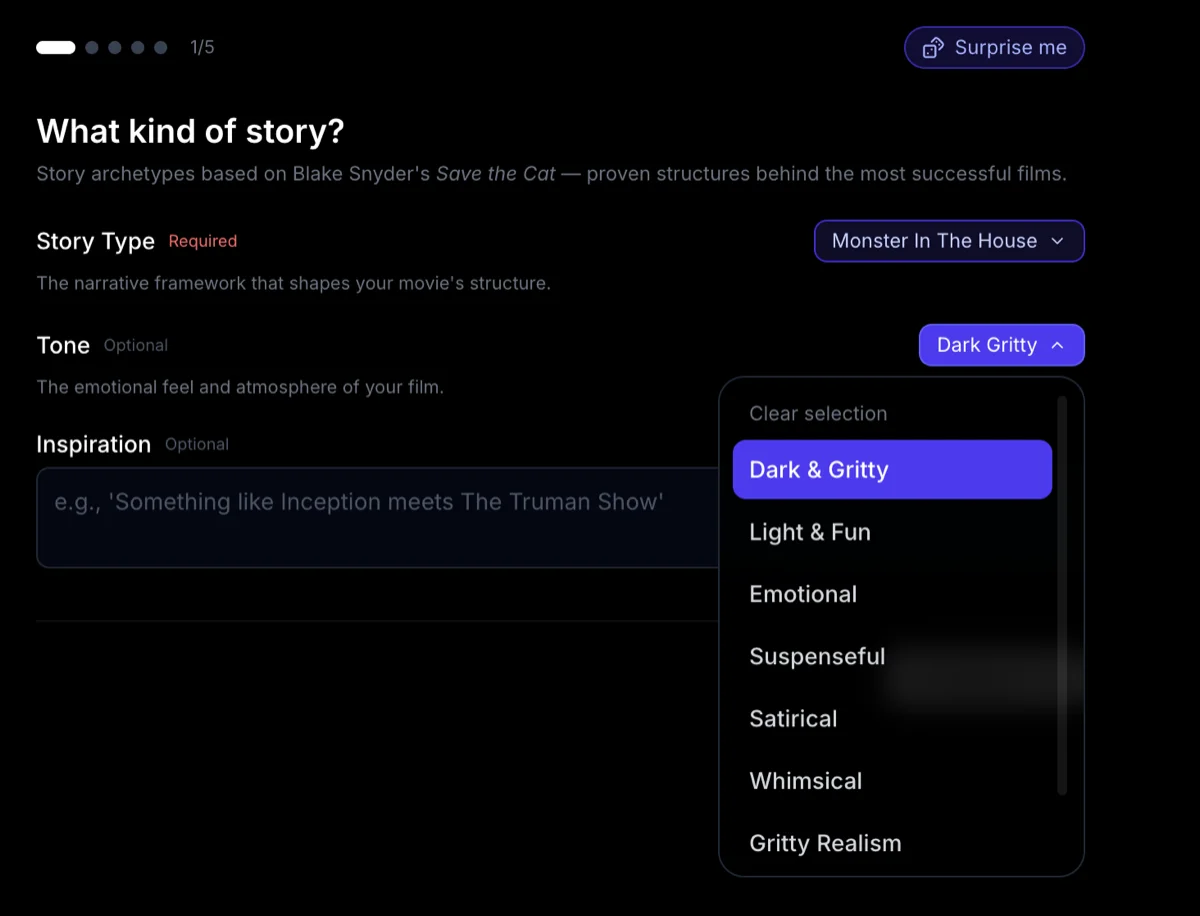
Step 1: Story Archetype
The archetype is the fundamental story structure your film follows. Choose from 10 archetypes based on Blake Snyder's Save the Cat! beat sheet system:
| Archetype | Core Story | Classic Example |
|---|---|---|
| Monster in the House | A group trapped with a threat they must survive or defeat | Jaws, Alien, A Quiet Place |
| Golden Fleece | A hero goes on a journey to find something and discovers themselves | Lord of the Rings, Finding Nemo, Mad Max: Fury Road |
| Out of the Bottle | Someone gets a wish or power, then must deal with the consequences | Groundhog Day, Liar Liar, Freaky Friday |
| Dude with a Problem | An ordinary person faces an extraordinary situation | Die Hard, Taken, The Martian |
| Rites of Passage | A character goes through a life-changing transition | Lady Bird, Boyhood, The Breakfast Club |
| Buddy Love | Two characters who need each other but might not realize it | Toy Story, Thelma & Louise, Good Will Hunting |
| Whydunit | Investigating a mystery or crime reveals deeper truths | Knives Out, Zodiac, Gone Girl |
| Fool Triumphant | An underestimated person prevails against all odds | Legally Blonde, Forrest Gump, Erin Brockovich |
| Institutionalized | A character within a group or system must choose: conform or rebel | One Flew Over the Cuckoo's Nest, The Shawshank Redemption |
| Superhero | A special person must rise to meet a challenge only they can face | Spider-Man, The Matrix, Unbreakable |
How to choose: Think about the emotional journey you want your audience to take. A Golden Fleece is about discovery and growth. A Monster in the House is about survival and fear. A Fool Triumphant is about the joy of the underdog winning.
Step 2: Tone
The tone defines the emotional flavor of your film. Choose from 8 options:
| Tone | What It Feels Like | Think Of |
|---|---|---|
| Dark & Gritty | Harsh, unflinching, morally complex | No Country for Old Men, Sicario |
| Light & Fun | Entertaining, fast-paced, uplifting | Ocean's Eleven, The Grand Budapest Hotel |
| Emotional | Moving, character-driven, tear-inducing | Up, Manchester by the Sea |
| Suspenseful | Tense, edge-of-seat, anxious | Zodiac, Prisoners |
| Satirical | Sharp, witty, socially observant | Don't Look Up, Get Out |
| Whimsical | Quirky, imaginative, charming | Amelie, The Secret Life of Walter Mitty |
| Gritty Realism | Authentic, raw, documentary-like | Moonlight, City of God |
| Surreal | Dreamlike, strange, reality-bending | Mulholland Drive, Everything Everywhere All at Once |
How to choose: The tone should match both your story archetype and your personal filmmaking sensibility. A Monster in the House with a "Light & Fun" tone gives you Ghostbusters. The same archetype with "Dark & Gritty" gives you Alien.
Step 3: Time Period
When your story takes place fundamentally shapes the world your characters inhabit. Choose from 10 time periods:
| Time Period | Setting |
|---|---|
| Ancient | Civilizations before the medieval era |
| Medieval | Castles, kingdoms, feudal societies |
| Victorian | 1837-1901, industrial revolution, rigid social classes |
| 1920s-1940s | Jazz age, prohibition, World War II |
| 1950s-1970s | Post-war boom, counterculture, cold war |
| 1980s-1990s | MTV era, end of cold war, early internet |
| Present Day | Contemporary setting, current technology |
| Near Future | 10-50 years ahead, recognizable but advanced |
| Far Future | Distant future, radically different world |
| Alternate History | Our world with a key historical divergence |
How to choose: The time period affects everything from technology to social norms to visual style. It also determines what conflicts are possible. A Dude with a Problem in the Medieval era is very different from one in the Near Future.
Step 4: Location
Where your story unfolds creates its physical and emotional landscape. Choose from 10 locations:
| Location | Characteristics |
|---|---|
| Small Town | Everyone knows everyone, secrets are hard to keep, community pressure |
| Big City | Anonymous, fast-paced, diverse, overwhelming |
| Rural | Isolated, natural, slow-paced, connected to the land |
| Suburban | Seemingly safe, conformity, hidden tensions |
| Isolated | Cut off from help, self-reliance, claustrophobic |
| Underground | Hidden worlds, subcultures, literal or metaphorical |
| Space | Vast, empty, technologically dependent, unknown |
| Fantasy Realm | Magical rules, mythical creatures, other worlds |
| Underwater | Alien environment, pressure, discovery |
| War Zone | Danger, moral complexity, survival, camaraderie |
How to choose: Location creates inherent dramatic tension. An Isolated location immediately raises the stakes because help is not coming. A Big City creates anonymity that works well for mystery and thriller stories.
Step 5: Hero Type
Your protagonist's fundamental nature drives how they respond to the story's challenges. Choose from 8 hero types:
| Hero Type | Defining Trait |
|---|---|
| Reluctant Hero | Does not want the adventure but cannot walk away |
| Anti-Hero | Morally grey, does the right thing for the wrong reasons (or vice versa) |
| Everyman | Ordinary person, relatable, in over their head |
| Chosen One | Destined for greatness, carries a special burden |
| Outcast | Rejected by society, operates on the margins |
| Mentor Figure | Wisdom from experience, guides others while facing their own demons |
| Trickster | Clever, adaptable, uses wit over force |
| Innocent | Pure-hearted, sees the world simply, moral compass for others |
How to choose: Your hero type should create interesting tension with the story archetype. A Reluctant Hero in a Superhero story is Spider-Man. An Anti-Hero in a Golden Fleece story is Mad Max. Look for combinations that create internal conflict.
Step 6: Hero's Flaw
Every compelling character has a flaw that holds them back. This is what they must overcome to complete their arc. Choose from 8 flaws:
| Flaw | How It Manifests |
|---|---|
| Hubris | Excessive pride, thinks they know better than everyone |
| Fear | Paralyzed by a specific fear that prevents action |
| Distrust | Cannot rely on others, pushes allies away |
| Addiction | Dependent on something destructive, whether substance or behavior |
| Naivety | Too trusting, does not see danger or deception |
| Anger | Volatile temper, acts before thinking, damages relationships |
| Guilt | Haunted by past actions, self-punishing, avoids risk |
| Obsession | Single-minded pursuit of one thing at the expense of everything else |
How to choose: The best flaws directly conflict with what the hero needs to do. A hero who needs to trust a team but has Distrust as their flaw creates natural dramatic tension. A Chosen One burdened with Guilt resists their destiny in a compelling way.
Step 7: Antagonist Type
The antagonist creates the central obstacle your hero must overcome. Choose from 6 types:
| Antagonist | Nature of the Conflict |
|---|---|
| Human Villain | A person with their own goals that directly oppose the hero |
| System/Institution | Bureaucracy, government, corporation, or social structure |
| Nature/Environment | Storms, wilderness, disease, or the physical world itself |
| Inner Demon | The hero's own psychology, addiction, trauma, or self-sabotage |
| Rival/Mirror | Someone similar to the hero who made different choices |
| Supernatural Entity | Something beyond natural understanding - ghost, demon, alien force |
How to choose: Different antagonist types create different kinds of stories. Human Villain gives you personal conflict with a face. System/Institution creates stories about fighting power structures. Inner Demon makes the story deeply psychological.
Step 8: Catalyst
The catalyst is the event that kicks the story into motion. It is the moment where normal life ends and the story begins. Choose from 8 catalysts:
| Catalyst | What Happens |
|---|---|
| Discovery | The hero finds something that changes everything |
| Loss | Someone or something important is taken away |
| Betrayal | A trusted person or institution breaks faith |
| Arrival of Stranger | A new person enters the hero's world and disrupts it |
| Accusation | The hero is blamed for something, justly or not |
| Natural Disaster | A catastrophic event upends the normal world |
| Mysterious Event | Something unexplainable happens that demands investigation |
| Call to Action | The hero is directly asked or compelled to act |
How to choose: The catalyst should feel both surprising and inevitable. It should connect naturally to your archetype: a Discovery works perfectly for a Whydunit, while Loss drives a Rites of Passage story.
Step 9: Theme
The theme is the deeper meaning your story explores. It is the question your film asks the audience to consider. Choose from 10 themes:
| Theme | The Story Asks |
|---|---|
| Redemption | Can people change? Can past wrongs be made right? |
| Sacrifice | What are you willing to give up for what matters? |
| Identity | Who are you, really? What makes you, you? |
| Power | What does power do to people? Who should have it? |
| Love | What would you do for the people you love? |
| Freedom | What does it mean to be truly free? What holds us back? |
| Justice | What is fair? Who decides? What does justice cost? |
| Truth | Is the truth always worth knowing? What happens when lies unravel? |
| Survival | What will you do to stay alive? What are you willing to lose? |
| Legacy | What do you leave behind? How will you be remembered? |
How to choose: The theme should resonate with your hero's flaw and arc. A hero with Guilt pursuing Redemption is classic for a reason. An Outcast hero exploring Identity creates a powerful character study.
What You Get
After selecting all 9 elements, the generator produces a complete movie concept. Here is what each piece gives you:
Title
A working title that captures the essence of your concept. Feel free to keep it or change it - the title is a starting point, not a commitment.
Logline
A one-sentence pitch that describes the core conflict: who the hero is, what they want, and what stands in their way. This is the sentence you would use to pitch the film.
Synopsis
A full story outline covering the three acts: setup, confrontation, and resolution. This shows how your chosen archetype, catalyst, and theme play out across the narrative.
Characters
Detailed descriptions of your hero and antagonist, including their backgrounds, motivations, and how they connect to the theme.
Making the Most of Generated Ideas
Generate Multiple Concepts
Since the generator is free, explore freely. Try different combinations:
- Same archetype with different tones
- Same hero type in different time periods
- Same theme with different catalysts
Each combination creates a meaningfully different film concept.
Use Ideas as Starting Points
The generated concepts are foundations, not finished scripts. Take what resonates and develop it further:
- Expand the synopsis into a treatment
- Develop supporting characters beyond hero and antagonist
- Add subplots that reinforce the theme
- Use the Melies script editor to flesh out scenes with AI assistance
Connect to Visual Production
Once you have a concept you love, use it to drive your Melies production:
- Create a movie poster using the Movie Poster Generator - this establishes the visual style
- Generate character images with the AI Image Generator - cast your characters using AI Actors or custom prompts
- Write the script using the built-in editor and AI writing assistant
- Generate scenes as images and then videos
- Build the film in the timeline
The Movie Idea Generator is step one of the complete AI filmmaking workflow AI Filmmaking: How to Create an AI Film from Idea to ExportLearn the complete AI filmmaking workflow with Melies. Generate ideas, cast AI actors, create storyboards, produce video clips, edit on a timeline, and export your finished AI film..
Combine Unexpected Elements
The most original ideas often come from unusual combinations. Try:
- Monster in the House + Whimsical + Victorian + Underwater
- Buddy Love + Dark & Gritty + Far Future + War Zone
- Fool Triumphant + Satirical + Present Day + Suburban
Unexpected combinations push the generator (and your creativity) into fresh territory.
What to Try Next
- Movie Idea Generator - Start generating ideas now
- 10 Story Archetypes Every Filmmaker Should Know
 10 Story Archetypes Every Filmmaker Should KnowMaster the 10 story archetypes used in filmmaking. Learn each story archetype pattern with classic film examples and how to use them for your next project. - Deep dive into archetypes
 - How to Create an AI Movie Poster
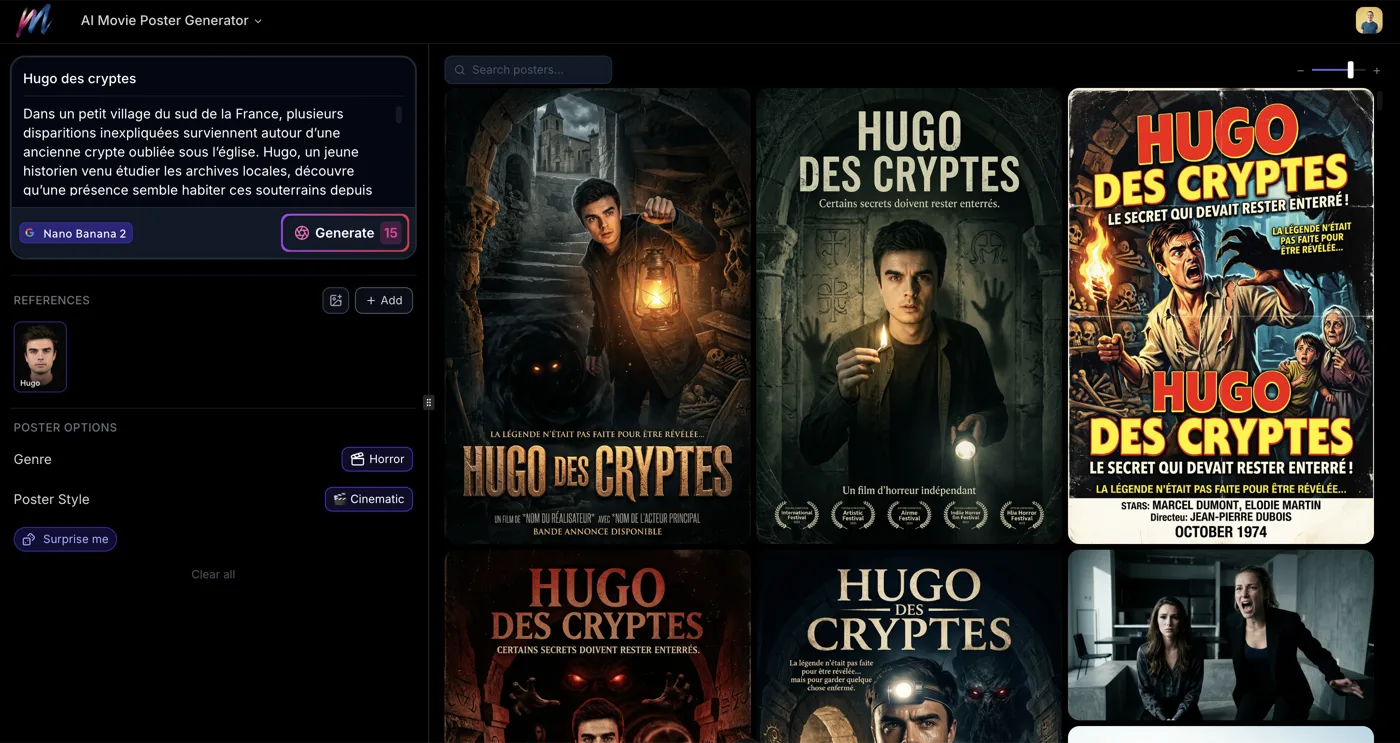 Movie Poster Generator: Create AI Movie Posters in MinutesUse the Melies movie poster generator to create professional AI movie posters. Choose from 20 styles, add titles and taglines, and generate stunning posters in minutes. - Visualize your concept
 - How to Create an AI FilmAI Filmmaking: How to Create an AI Film from Idea to ExportLearn the complete AI filmmaking workflow with Melies. Generate ideas, cast AI actors, create storyboards, produce video clips, edit on a timeline, and export your finished AI film. - Full production pipeline
- AI Image Generator - Start generating visuals from your idea